Yes...

Yes...
You can use this old faerie call: "Come out from your faerie bower... Come out on this golden hour... Come out to me faeries, please, faeries dancing on the breeze."

Tuesday, March 27, 2018

The Folklore Of Fairy Rings...


"Plucked from the Fairy Circle"
A man saves his friend from the grip of a fairy ringA great deal of folklore surrounds fairy rings. Their names in European languages often allude to supernatural origins; they are known as ronds de sorciers ("sorcerers' rings") in France, and Hexenringe ("witches' rings") in German. In German tradition, fairy rings were thought to mark the site of witches' dancing on Walpurgis Night, and Dutch superstition claimed that the circles show where the Devil set his milk churn. In Tyrol, folklore attributed fairy rings to the fiery tails of flying dragons; once a dragon had created such a circle, nothing but toadstools could grow there for seven years. European superstitions routinely warned against entering a fairy ring. French tradition reported that fairy rings were guarded by giant bug-eyed toads that cursed those who violated the circles. In other parts of Europe, entering a fairy ring would result in the loss of an eye. Fairy rings are associated with diminutive spirits in the Philippin

Fairy rings in moss in IcelandThe folklores of the British Isles contain a wealth of fairy lore, including the idea from which fairy rings take their name: the phenomena result from the dancing of fairies. In 19th-century Wales, where the rings are known as cylch y Tylwyth Teg, fairies were almost invariably described as dancing in a group when encountered,[43] and in Scotland and Wales in the late 20th century, stories about fairy rings were still common; ] some Welsh even claimed to have joined a fairy dance.  Victorian folklorists regarded fairies and witches as related, based in part on the idea that both were believed to dance in circles.  These revels are particularly associated with moonlit nights, the rings only becoming visible to mortals the following morning.  Local variants add other details. An early 20th-century Irish tradition says that fairies enjoy dancing around the hawthorn tree so that fairy rings often centre on one.  One resident of Balquhidder, Scotland, said that the fairies sit on the mushrooms and use them as dinnertables,  and a Welsh woman claimed that fairies used the mushrooms as parasols and umbrellas.  Olaus Magnus in Historia de Gentibus Septentrionalibus wrote that the brightness of the fairy ring comes not from the dancing of the fairies, who harm it with their feet, but from Puck, who refreshes the grass.[51] A Devon legend says that a black hen and chickens sometimes appear at dusk in a large fairy ring on the edge of Dartmoor.  A Welsh and Manx variant current in the 1960s removes dancing from the picture and claims that fairy rings spring up over an underground fairy village.[53] These associations have become linked to specific sites. For example, "The Pixies' Church" was a rock formation in Dartmoor surrounded by a fairy ring,[54] and a stone circle tops Cader Idris in northern Wales, believed to be a popular spot for fairy dances. Guernsey Fairy Ring is also a popular spot for fairie dancing and known for having evil fairies living there.
Many folk beliefs generally paint fairy rings as dangerous places, best avoided.  Sikes traces these stories of people trespassing into forbidden territory and being punished for it to the tale of Psyche and Eros. In it, Psyche is forbidden to view her lover, and when she does so, her palace disappears and she is left alone. Superstition calls fairy circles sacred and warns against violating them lest the interloper (such as a farmer with a plough) anger the fairies and be cursed.  In an Irish legend recorded by Wilde, a farmer builds a barn on a fairy ring despite the protests of his neighbours. He is struck senseless one night, and a local "fairy doctor" breaks the curse. The farmer says that he dreamed that he must destroy the barn.[60] Even collecting dew from the grass or flowers of a fairy ring can bring bad luck. Destroying a fairy ring is unlucky and fruitless; superstition says it will just grow back.
A traditional Scottish rhyme sums up the danger of such places:
He wha tills the fairies' green
Nae luck again shall hae :
And he wha spills the fairies' ring
Betide him want and wae.
For weirdless days and weary nights
Are his till his deein' day.
But he wha gaes by the fairy ring,
Nae dule nor pine shall see,
And he wha cleans the fairy ring
An easy death shall dee.
Numerous legends focus on mortals entering a fairy ring—and the consequences. One superstition is that anyone who steps into an empty fairy ring will die at a young age.  A 20th-century tradition from Somerset calls the fairy ring a "galley-trap" and says that a murderer or thief who walks in the ring will be hanged.  Most often, someone who violates a fairy perimeter becomes invisible to mortals outside and may find it impossible to leave the circle. Often, the fairies force the mortal to dance to the point of exhaustion, death, or madness.  In Welsh tales, fairies actively try to lure mortals into their circles to dance with them.  A tale from the Cambrian Mountains of Wales, current in the 19th century, describes a mortal's encounter with a fairy ring:
... he saw the Tylwyth Teg, in appearance like tiny soldiers, dancing in a ring. He set out for the scene of revelry, and soon drew near the ring where, in a gay company of males and females, they were footing it to the music of the harp. Never had he seen such handsome people, nor any so enchantingly cheerful. They beckoned him with laughing faces to join them as they leaned backward almost falling, whirling round and round with joined hands. Those who were dancing never swerved from the perfect circle; but some were clambering over the old cromlech, and others chasing each other with surprising swiftness and the greatest glee. Still others rode about on small white horses of the most beautiful form ... All this was in silence, for the shepherd could not hear the harps, though he saw them. But now he drew nearer to the circle, and finally ventured to put his foot in the magic ring. The instant he did this, his ears were charmed with strains of the most melodious music he had ever heard.
Entering the ring on May Eve or Halloween night was especially dangerous.  One source near Afon fach Blaen y Cae, a tributary of the Dwyfach, tells of a shepherd accidentally disturbing a ring of rushes where fairies are preparing to dance; they capture him and hold him captive, and he even marries one of them. In variants from Scotland recorded by Edwin Sidney Hartland in 1891, the ring is replaced by a cavern or an old mill.
Freedom from a fairy ring often requires outside intervention. A tactic from early 20th-century Wales is to cast wild marjoram and thyme into the circle and befuddle the fairies; another asks the rescuer to touch the victim with ironOther stories require that the enchanted victim simply be plucked out by someone on the outside,  although even this can be difficult: A farmer in a tale from the Llangollen region has to tie a rope around himself and enlist four men to pull him from the circle as he goes in to save his daughter.[71] Other folk methods rely on Christian faith to break the enchantment: a stick from a rowan tree (thought to be the wood from which the cross of Jesus Christ was built) can break the curse, as can a simple phrase such as "what, in Heaven's name", as in a 19th-century tale from Carmarthenshire. A common element to these recoveries is that the rescuer must wait a year and a day from when the victim entered the ring.
Mortals who have danced with the fairies are rarely safe after being saved from their enthrallment. Often, they find that what seemed to be but a brief foray into fairyland was indeed much longer in the mortal realm, possibly weeks or years. The person rescued from the fairy ring may have no memory of their encounter with the sprites, as in a story from Anglesea recorded in 1891.  In most tales, the saved interlopers face a grim fate. For example, in a legend from Carmarthenshire, recorded by Sikes, a man is rescued from a fairy ring only to crumble to dust.  In a tale from Mathavarn, Llanwrin Parish, a fairy-ring survivor moulders away when he eats his first bite of food.  Another vulnerability seems to be iron; in a tale from the Aberystwyth region, a touch from the metal causes a rescued woman to disappear.
Some legends assert that the only safe way to investigate a fairy ring is to run around it nine times. This affords the ability to hear the fairies dancing and frolicking underground. According to a 20th-century tradition of Northumberland, this must be done under a full moon, and the runner must travel in the direction of the sun; to go widdershins allows the fairies to place the runner under their sway. To circle the ring a tenth time is foolhardy and dangerous. Keightley recorded a similar tradition from Northumberland in 1905: "The children constantly run this number [nine times], but nothing will induce them to venture a tenth run." A story from early 20th century England says that a mortal can see the sprites without fear if a friend places a foot on that of the person stepping beyond the circle's perimeter.[76] Another superstition says that wearing a hat backwards can confuse the fairies and prevent them from pulling the wearer into their ring.
Although they have strong associations with doom, some legends paint fairy circles as places of fertility and fortune. Welsh folk belief is that mountain sheep that eat the grass of a fairy ring flourish, and that crops sown from such a place will prove more bountiful than those from normal land. A folk belief recorded in the Athenian Oracle claims that a house built on a fairy circle will bring prosperity to its inhabitants.[78] Likewise, a legend from Pont y Wern says that in the 13th or 14th century, the inhabitants of the town of Corwrion watched fairies dancing in a ring around a glow worm every Sunday after church at a place called Pen y Bonc. They even joined the sprites in their revels. The legend survives in a rhyme: "With the fairies nimbly dancing round / The glow-worm on the Rising Ground." A Welsh tale recorded by Rhys in 1901 tells of a man who supposedly lived on the side of the Berwyn, above Cwm Pennant, in the early 19th century. The man destroyed a nest of rooks in a tree surrounded by a fairy ring. In gratitude, the fairies gave him a half crown every day but stopped when he told his friends, "for he had broken the rule of the fair folks by making their liberality known".[80] Nevertheless, fairy boons are not without their curses, and tales often tell of the sprites exacting their revenge.

Tuesday, February 27, 2018

How To Grow Lily Of The Valley...


Around since at least 1000 B.C., lily of the valley plants are one of the most fragrant blooming plants in the spring and early summer throughout the northern temperate zone. The stems are covered with tiny white, nodding bell-shaped flowers that have a sweet perfume and medium-bright green leaves that are lance-shaped, 4 to 8 inches high and 3 to 5 inches wide. 

This moisture loving plant forms a spreading mass with red seed pods remaining after flowering, which makes lily of the valley attractive after blooming and very carefree. Growing lily of the valley plants (Convallaria majalis) is easy, as they will remain perennial in USDA Zones 2-9. Growing Lily of the Valley This easy-care plant doesn’t require much to thrive. Preferring partial shade and a moist soil, growing lily of the valley is easy if you know how and when to plant. That being said, these plants are adaptable and will grow very well in dry shade too. 

Lily of the valley can also be adapted to full sun or full shade, depending on the amount of moisture it receives. When purchasing plants, look for the following cultivars: Convallaria majalis ‘Albostriata’ – This type has dark leaves with white to cream longitudinal stripes. ‘Aureomarginata’ – This variety has cream to yellow edged leaves. Rosea – A pink variety, not as vigorous as the white flowered species but very pretty. Convallaria majuscule ‘Greene’ – This North American native is great for naturalistic ground cover and provides a carpet of beauty between other native plants. When to Plant Lily of the Valley Knowing when to plant lily of the valley will help to ensure its survival in your garden. Planting lily of the valley should take place by late fall. Cool winter temperatures are required to allow a proper dormancy period. The single underground rhizomes of this plant, which are known as “pips”, can be divided anytime after flowering. November or December would be the ideal time for division and planting lily of the valley. Care should be taken when planting as it is a poisonous plant, so keep it away from children and pets. Try planting lily of the valley plants in a naturalistic garden. Planting lily of the valley in outdoor containers would also be a great way to control its spread and provide it with the moisture it enjoys. No matter what method you choose for growing lily of the valley, you will find that lily of the valley care is easy and worth the rewards. 

Read more at Gardening Know How: Growing Lily Of the Valley: When To Plant Lily Of The Valley https://www.gardeningknowhow.com/ornamental/bulbs/lily-of-the-valley/growing-lily-of-the-valley.htm

Lily Of The Valley...

Description

Convallaria majalis is a herbaceous perennial plant that forms extensive colonies by spreading underground stems called rhizomes. New upright shoots are formed at the ends of stolons in summer,[4] these upright dormant stems are often called pips.[5] These grow in the spring into new leafy shoots that still remain connected to the other shoots under ground, often forming extensive colonies. The stems grow to 15–30 cm tall, with one or two leaves 10–25 cm long; flowering stems have two leaves and a raceme of 5–15 flowers on the stem apex.
The flowers have six white tepals (rarely pink), fused at the base to form a bell-shape, 5–10 mm diameter, and sweetly scented; flowering is in late spring, in mild winters in the Northern Hemisphere it is in early March. The fruit is a small orange-red berry 5–7 mm diameter that contains a few large whitish to brownish colored seeds that dry to a clear translucent round bead 1–3 mm wide. Plants are self-sterile, and colonies consisting of a single clone do not set seed.[6]

Distribution


19th-century illustration
Convallaria majalis is a native of Europe, where it largely avoids the Mediterranean and Atlantic margins. An eastern variety, C. majalis var. keiskei occurs in Japan and parts of eastern Asia. A limited native population of C. majalis var. montana occurs in the Eastern United States.[8] There is, however, some debate as to the native status of the American variety.
Like many perennial flowering plants, C. majalis exhibits dual reproductive modes by producing offspring asexually by vegetative means and by seed, produced via the fusion of gametes.

Ecology

Convallaria majalis is a plant of partial shade, and mesophile type that prefers warm summers. It likes soils that are silty or sandy and acid to moderately alkaline, with preferably a plentiful amount of humus. The Royal Horticultural Society states that slightly alkaline soils are the most favoured. It is an Euroasiatic and suboceanic species that lives in mountains up to 1,500 m altitude.
Convallaria majalis is used as a food plant by the larvae of some Lepidoptera species including the grey chi. Adults and larvae of the leaf beetle Lilioceris merdigera are also able to tolerate the cardenolides and thus feed on the leaves.

Taxonomy


Convallaria majalis var. rosea
There are three varieties that have sometimes been separated out as distinct species or subspecies by some botanists.[15]
  • Convallaria majalis var. keiskei – from China and Japan, with red fruit and bowl-shaped flowers (now widely cited as Convallaria keiskei)[6][16]
  • C. majalis var. majalis – from Eurasia, with white midribs on the flowers
  • C. majalis var. montana – from the United States, with green-tinted midribs on the flowers
Convallaria transcaucasica is recognised as a distinct species by some authorities, while the species formerly called Convallaria japonica is now classified as Ophiopogon japonicus.[16]

Cultivation


Variegated cultivar early in spring

Double-flowered Convallaria majalis

Berries
Convallaria majalis is widely grown in gardens for its scented flowers and ground-covering abilities in shady locations. It has gained the Royal Horticultural Society's Award of Garden Merit. (confirmed 2017).] In favourable conditions it can form large colonies.
Various kinds and cultivars are grown, including those with double flowers, rose-colored flowers, variegated foliage and ones that grow larger than the typical species.
  • C. majalis 'Albostriata' has white-striped leaves
  • C. majalis 'Green Tapestry', 'Haldon Grange', 'Hardwick Hall', 'Hofheim', 'Marcel', 'Variegata' and 'Vic Pawlowski's Gold' are other variegated cultivars[
  • C. majalis 'Berlin Giant' and C. majalis 'Géant de Fortin' (syn. 'Fortin's Giant') are larger-growing cultivars
  • C. majalis 'Flore Pleno' has double flowers.
  • C. majalis 'Rosea' sometimes found under the name C. majalis var. rosea, has pink flowers.
Traditionally Convallaria majalis has been grown in pots and winter forced to provide flowers during the winter months, both for as potted plants and as cut flowers.

Chemistry

All parts of the plant are highly poisonous, including the red berries which may be attractive to children.  If ingested—even in small amounts—the plant can cause abdominal pain, vomiting, reduced heart rate, blurred vision, drowsiness, and red skin rashes.
Roughly different cardiac glycosides (cardenolides) have been found in the plant, including among others:
  • convallarin
  • convallamarin
  • convallatoxin
  • convallotoxoloside
  • convallosid
  • neoconvalloside
  • glucoconvalloside
  • majaloside
  • convallatoxon
  • corglycon
  • cannogenol-3-O-α-L-rhamnoside
  • cannogenol-3-O-β-D-allomethyloside
  • cannogenol-3-O-6-deoxy-β-D-allosido-β-D-glucoside,
  • cannogenol-3-O-6-deoxy-β-D-allosido-α-L-rhamnoside,
  • strophanthidin-3-O-6-deoxy-β-D-allosido-α-L-rhamnoside,
  • strophanthidin-3-O-6-deoxy-β-D-allosido-α-L-arabinoside,
  • strophanthidin-3-O-α-L-rhamnosido-2-β-D-glucoside,
  • sarmentogenin-3-O-6-deoxy-β-D-allosido-α-L-rhamnoside
  • sarmentogenin-3-O-6-deoxy-β-D-guloside
  • 19-hydroxy-sarmentogenin-3-O-α-L-rhamnoside,
  • 19-hydroxy-sarmentogenin
  • arabinosido-6-deoxyallose
  • lokundjoside
The plant also contains saponins. Although deadly, the plant has been used as a folk remedy in moderate amounts, and is currently used by herbalists as a restricted herbal remedy. It also contains the unusual, poisonous amino acid azetidine-2-carboxylic acid.
The odor of lily of the valley, specifically the ligand bourgeonal, attracts mammalian sperm. The 2003 discovery of this phenomenon prompted research into odor reception,  but a 2012 study demonstrated instead that at high concentrations, bourgeonal imitated the role of progesterone in stimulating sperm to swim (chemotaxis), a process unrelated to odor reception.

Uses

Perfume

In 1956, the French firm Dior produced a fragrance simulating lily of the valley, which was Christian Dior's favorite flower. Diorissimo was designed by Edmond Roudnitska. Although it has since been reformulated, it is considered a classic.
Other perfumes imitating or based on the flower include Henri Robert's Muguet de Bois (1936), Penhaligon's Lily of the Valley (1976), and Olivia Giacobetti's En Passant (2000).

Monday, February 12, 2018

"The Rose," - By Bette Midler...


I LOVE roses!!!...  I'm already planning to enlarge my rose garden on the south side of my yard.  I plan to plant Tuscany, Ebb Tide, Cardinal Richelieu and Montrose, --- all dark red or purple Old World roses.


Cardinal Richelieu

Sunday, February 11, 2018

One Of My Favorite Old World Roses, --- Tuscany...


If You Live In A Harsh Climate You Can Still Grow Hybrid Tea Roses In Pots!!!...

I DO!!!...  The second rose in the pics is a Peace rose, 5 inches across when in full bloom!!!  The bottom one is a John F. Kennedy...


All these in the pics, above, grow on my south facing porch in pots...

After a few years of having my gorgeous hybrid tea roses killed by the frigid winter temperatures of Ohio, [15 degrees below zero one year!!!], I started to grow hybrid tea roses in pots, which I place on my porch once the weather is consistently warm, night temps in the 50s or higher.

They stay there until Fall, when the nights get chilly, where I live, in growing zone 5.  Then, I bring my roses inside for the winter.  They stay in a cool and sunny back bedroom.  I make sure that the soil in their pots stays moist, but not soaking.  [Roses are elegant ladies.  They don't like to have "their feet" wet.]  This usually means watering them about every week and a half.  They may look dead in the winter, but, believe me, their roots are probably alive.  So, don't throw them out, or let their roots dry out!!!  Roses go dormant in winter, like perennials DO!!!  Just be patient.  Hey, I too, can look a little scraggly in the winter!!!

I don't trim my roses, for bloom, --- until March.  Then, I cut out all their dead wood, the dry lifeless branches that show no sprouts.  I fertilize them in April, rose planting month, and re-pot them in larger pots, if I think they need it.  I add a little fresh soil on the top of each pot, regardless.  I fertilize my roses once per month, during their growing period, April to August, with liquid fertilizer, or I make up regular rose fertilizer till the powder is completely dissolved in water, so it won't be too strong on their roots, which are confined in their pots.   

I usually have early blooms on my pot roses, in the first part of May.  My Old World roses are much tougher.  They bloom once, in June, spending the whole year outside in my garden with little to no winter protection.  I don't trim my Old World roses for bloom.  I only cut out their dead wood.  Sometimes, my Old World roses suffer a bit from harsh Ohio winters, but they usually don't die completely.  Most of them are over 15 years old and have very strong roots.  A few years ago the temperature at night on Feburary 15th went down to 15 below zero!!!...  Just AWFUL!!!...  I thought, for sure, that artic-like night had killed all my outdoor roses.  They suffered, BUT they LIVED!!!...  JUST REMARKABLE!!!  :D

I usually can't resist buying a couple of new hybrid teas for pots each year, or a new Old World rose for my garden.  Sometimes, I wait all the way until Fall, then I go to the garden centers to get the summer's roses on sale.   I got a gorgeous very fragrant  John F. Kennedy red rose last year for 75% off!!!  WOW, --- GREAT DEAL!!!  Yes, yes, yes, you CAN plant a rose in November, as long as the weather is still warm, and expect it to bloom the next late Spring or Summer.  :D   

The Beautiful Old World Rose Cardinal Richelieu...


Saturday, February 10, 2018

I'm Looking Forward To Spring... Believe Me, It IS Coming!!!...


These are all growing on my place...  From top to bottom, --- ground ivy, ajuga, wild strawberry blossoms & sweet woodruff & ground ivy, sweet woodruff, wild white faerie roses, primroses, violets.  

Sunday, December 31, 2017

The Wassail Bowl...


Wassail is a hot, mulled punch often associated with Yuletide, drunk from a 'wassailing bowl'. The earliest versions were warmed mead into which roasted crab apples were dropped and burst to create a drink called 'lambswool' drunk on Lammas day, still known in Shakespeare's time.[2] Later, the drink evolved to become a mulled cider made with sugar, cinnamonginger and nutmeg, topped with slices of toast as sops and drunk from a large communal bowl. Modern recipes begin with a base of wine, fruit juice or mulled ale, sometimes with brandy or sherry added. Apples or oranges are often added to the mix, and some recipes also call for beaten eggs to be tempered into the drink. Great bowls turned from wood, pottery or tin often had many handles for shared drinking and highly decorated lids; antique examples can still be found in traditional pubs.Hence the first stanza of the traditional carol the Gloucestershire Wassail dating back to the Middle Ages.
Wassail! wassail! all over the town,
Our toast it is white and our ale it is brown;
Our bowl it is made of the white maple tree;
With the wassailing bowl, we'll drink unto thee.
At Carhampton, near Minehead, the Apple Orchard Wassailing is held on the old Twelfth Night (17 January) as a ritual to ask the Gods for a good apple harvest. The villagers form a circle around the largest apple tree, hang pieces of toast soaked in cider in the branches for the robins, who represent the 'good spirits' of the tree. A shotgun is fired overhead to scare away evil spirits and the group sings, the following being the last verse,
Old Apple tree, old apple tree;
We've come to wassail thee;
To bear and to bow apples enow;
Hats full, caps full, three bushel bags full;
Barn floors full and a little heap under the stairs.

Lamb's wool

Lamb's wool or lambswool is a variety of wassail made from ale, baked apples, sugar and spices.[
Next crowne the bowle full of
With gentle Lambs wooll,
Adde sugar, nutmeg, and ginger,
With store of ale too,
And thus ye must doe
To make the Wassaile a swinger.
Irish antiquarian Charles Vallancey proposed that the name "lambswool" was a corruption of the name of a pagan Irish festival, "Lamas Ubhal", during which a similar drink was had. Alternatively, the name may derive from the drink's similar appearance to the wool of lambs. Ale is occasionally replaced by ginger ale for children, especially around Halloween and New Year.

Culture

This drink would be roughly equivalent to beer or wine in many contemporary Western cultures. People drank it at social gatherings. "Come butler, come fill us a bowl of the best/... please God send our master a good cask of ale..." sung throughout the towns of the Germanic nations, sending good luck to one's master in the new year.

Wassailing

Here's to thee, old apple tree,
That blooms well, bears well.
Hats full, caps full,
Three bushel bags full,
An' all under one tree. Hurrah! Hurrah!
Here’s to thee, old apple-tree,
Whence thou mayst bud, and whence thou mayst blow,
And whence thou mayst bear apples enow! [enough]
Hats-full! Caps-full!
Bushel, bushel sacks-full!
And my pockets full, too! Hurra![10]
In the cider-producing counties in the South West of England (primarily Cornwall,  Devon, Somerset, Dorset, Gloucestershire and Herefordshire) or South East England (Kent, Sussex, Essex and Suffolk) wassailing refers to a traditional ceremony that involves singing and drinking to the health of trees on Twelfth Night in the hopes that they might better thrive. The purpose of wassailing is to awaken the cider apple trees and to scare away evil spirits to ensure a good harvest of fruit in the Autumn.The ceremonies of each wassail vary from village to village but they generally all have the same core elements. A wassail King and Queen lead the song and/or a processional tune to be played/sung from one orchard to the next; the wassail Queen is then lifted into the boughs of the tree where she places toast soaked in wassail from the clayen cup as a gift to the tree spirits (and to show the fruits created the previous year). In some counties the youngest boy or "Tom Tit" will stand in for the Queen and hang the cider soaked toast in the tree. Then an incantation is usually recited.
A folktale from Somerset reflecting this custom tells of the Apple Tree Man, the spirit of the oldest apple tree in an orchard, and in whom the fertility of the orchard is thought to reside. In the tale a man offers his last mug of mulled cider to the trees in his orchard and is rewarded by the Apple Tree Man who reveals to him the location of buried gold.

Sunday, December 24, 2017

The Birch Tree, --- & It's Many Uses...


Birch-the symbol of Russia


The emblem of middle region forests of Russia is white-trunk birch. White-trunk birch became a symbol of spring, light and love to the fatherland. The word “birch” is very ancient and is connected with the verb “to keep, to take care”, since the Slavs considered the birch as the protecting people gift of God. The year began with spring and people celebrated it not with fir, but with the birch.

The birch was necessary planted near the houses, people tried to surround the village by “protecting” belt of birches, as they believed that “birch spirit” can guard against cholera and another diseases. The birch was planted near the gate, there was a bank and people could speak with a tree and ask it to give them might and strength. Birch forest is light and clean and is always full of birds, berries and mushrooms.

It is really hard to imagine the Russian sauna without the birch broom. Phytoncides out of leaves and buds sterilize the air. Especially successfully they cope with pathogens of typhoid fever, tuberculosis and diphtheria.

The birch was widely used in a peasants’ life, and first ways of Slavs’ written language was made on the birch bark and was preserved in the ground till now.

Birch sap is the sap extracted from a birch tree, such as a North American Sweet Birch or a Silver Birch. The sap is often a slightly sweet, thin syrupy-watery liquid. The tree sap contains sugars (namely xylitol), proteins, amino acids, and enzymes.

Birch sap must be collected during a specific time of the year, depending on the species and geography, at the break of winter and spring when the sap moves intensively, typically between the first thaws and the start of bud development. The collected sap can be drunk as a tonic and it is a traditional beverage in Russia.

Birch sap collection is done by tying a bottle to the tree, drilling a hole into its trunk and leading the sap to the bottle by a plastic tube. A small birch (trunk diameter about 15 cm) can produce up to 5 liters of sap per day, a larger tree (diameter 30 cm) up to 15 liters per day. Birch sap has to be collected in early Spring before any green leaves have appeared, as in late Spring it becomes bitter. The collection period is only about a month per year.

Березовый сок
«Березовый сок» на Яндекс.Фотках
Birch sap may be consumed both fresh and naturally fermented. It is a very refreshing drink.

Birch sap can also be used as an ingredient in food or drinks, such as birch beer or wintergreen flavored candy. Concentrated birch sap is used to make birch syrup In Russia this tonic is used as a traditional herbal medicine functioning as antiseptic, anti-parasitic, anti-inflammatory, and anti-itching treatment.

Fresh birch sap is highly perishable; even if refrigerated, it is stable for only up to 2-5 days. Shelf life can be prolonged by freezing or pasteurization. However pasteurization destroys some ingredients and can alter the taste of the product. Frozen birch sap is fairly stable.

Also, they stored birch brooms, covered roofs with the birch bark, made boats, clothes, shoes out of this material; they braided boxes, punnets, in which honey, milk, berries and other products could be kept for a long time. Moreover the birch bark was added to the dough.

Krasheninnikov S. P. describes the scenes of Kamchadals’ life (1948).
The bark, catkins and new branches was a source of vitamins. Kamchadals fine minced unripe bark and eat it with dry caviar, make sour bark with birch juice.

The healing properties of the birch are known from time immemorial. There are many pieces of advice in different herbals of the XVI – XVII centuries.

This tree gives everything to people for their health: juice, catkins, leaves, bark, new branches, tender thin roots, birch coal, tar. Also it has bioenergetic therapeutic effect. A man fells himself sprightly, calm and full of strengths of life in the birch forest.

Since olden days the birch bark considered as very important medicinal raw material, with the help of which people treated the diseases of joints, urinary and nervous systems. The Slavs sprinkled the wounds with the ground birch bark for its fast healing.

Thursday, December 21, 2017

Yule & It's Traditions, --- From "Celtic Connections"...

The Winter Solstice - Yule Lore
The date of this sabbat varies from December 20 to December 23 depending on the year in the Gregorian calendar.  The winter solstice is celebrated at this time in the northern hemisphere but it is now time to celebrate the summer solstice (Litha) in the southern hemisphere due to the seasonal differences.
Yule, (pronounced EWE-elle) is when the dark half of the year relinquishes to the light half. Starting the next morning at sunrise, the sun climbs just a little higher and stays a little longer in the sky each day. Known as Solstice Night, or the longest night of the year, the sun's "rebirth" was celebrated with much joy. On this night, our ancestors celebrated the rebirth of the Oak King, the Sun King, the Giver of Life that warmed the frozen Earth. From this day forward, the days would become longer.
Bonfires were lit in the fields, and crops and trees were "wassailed" with toasts of spiced cider.  Children were escorted from house to house with gifts of clove spiked apples and oranges which were laid in baskets of evergreen boughs and wheat stalks dusted with flour. The apples and oranges represented the sun.  The boughs were symbolic of immortality (evergreens were sacred to the Celts because they did not "die" thereby representing the eternal aspect of the Divine). The wheat stalks portrayed the harvest, and the flour was accomplishment of triumph, light, and life. Holly and ivy not only decorated the outside, but also the inside of homes, in hopes Nature Sprites would come and join the celebration. A sprig of Holly was kept near the door all year long as a constant invitation for good fortune to visit tthe residents.Mistletoe was also hung as decoration.  It represented the seed of the Divine, and at Midwinter, the Druids would travel deep into the forest to harvest it.

The ceremonial Yule log was the highlight of the Solstice festival. In accordance to tradition, the log must either have been harvested from the householder's land, or given as a gift... it must never have been bought. Once dragged into the house and placed in the fireplace it was decorated in seasonal greenery, doused with cider or ale, and dusted with flour before set ablaze by a piece of last years log, (held onto for just this purpose). The log would burn throughout the night, then smolder for 12 days after before being ceremonially put out. Ash is the traditional wood of the Yule log. It is the sacred world tree of the Teutons, known as Yggdrasil. An herb of the Sun, Ash brings light into the hearth at the Solstice.

A different type of Yule log, and perhaps one more suitable for modern practitioners would be the type that is used as a base to hold three candles. Find a smaller branch of oak or pine, and flatten one side so it sets upright. Drill three holes in the top side to hold red, green, and white (season), green, gold, and black (the Sun God), or white, red, and black (the Great Goddess). Continue to decorate with greenery, red and gold bows, rosebuds, cloves, and dust with flour.
Many customs created around Yule are identified with Christmas today.  If you decorate your home with a Yule tree, holly or candles, you are following some of these old traditions.   The Yule log, (usually made from a piece of wood saved from the previous year) is burned in the fire to symbolize the Newborn Sun/Son.
Deities of Yule:  All Newborn Gods, Sun Gods, Mother Goddesses, and Triple Goddesses. The best known would be the Dagda, and Brighid, the daughter of the Dagda. Brighid taught the smiths the arts of fire tending and the secrets of metal work. Brighid's flame, like the flame of the new light, pierces the darkness of the spirit and mind, while the Dagda's cauldron assures that Nature will always provide for all the children.

Symbolism of Yule:
Rebirth of the Sun, The longest night of the year, The Winter Solstice, Introspect, Planning for the Future.

Symbols of Yule:
Yule log, or small Yule log with 3 candles, evergreen boughs or wreaths, holly, mistletoe hung in doorways, gold pillar candles, baskets of clove studded fruit, a simmering pot of wassail, poinsettias, christmas cactus.

Herbs of Yule:
Bayberry, blessed thistle, evergreen, frankincense holly, laurel, mistletoe, oak, pine, sage, yellow cedar.

Foods of Yule:
Cookies and caraway cakes soaked in cider, fruits, nuts, pork dishes, turkey, eggnog, ginger tea, spiced cider, wassail, or lamb's wool (ale, sugar, nutmeg, roasted apples).

Incense of Yule:
Pine, cedar, bayberry, cinnamon.

Colors of Yule:
Red, green, gold, white, silver, yellow, orange.

Stones of Yule:
Rubies, bloodstones, garnets, emeralds, diamonds.

Activities of Yule:
Caroling, wassailing the trees, burning the Yule log, decorating the Yule tree, exchanging of presents, kissing under the mistletoe, honoring Kriss Kringle the Germanic Pagan God of Yule

Spellworkings of Yule:
Peace, harmony, love, and increased happiness.

Deities of Yule:
Goddesses-Brighid, Isis, Demeter, Gaea, Diana, The Great Mother. Gods-Apollo, Ra, Odin, Lugh, The Oak King, The Horned One, The Green Man, The Divine Child, Mabon. 

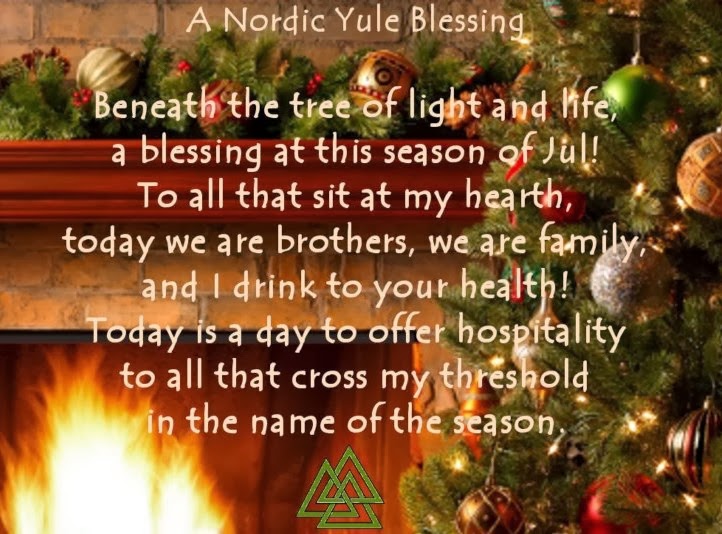
A Wonderful Nordic Yule Blessing...

Thursday, December 14, 2017

Homemade Stovetop Christmas Potpourri...

...

This smells luscious!!!...  I make it in a crockpot.  :D :D :D  Ho-ho-HO!!!

Thursday, December 7, 2017

What Is Bay Rum???... How Is It Made???...

It is a distillate that was originally made in Saint Thomas "and probably other West Indian islands" from rum and the leaves and/or berries of the West Indian bay tree, Pimenta racemosa.
John Maisch identified the leaf in the herbarium at the Philadelphia Academy of Natural Sciences, collected in St Croix, "by the late Dr, Griffith", which was identified as Myrcia acris, now transferred to the genus Pimenta. Maisch added that it was "very probable that various species are made use of for the same purpose." Other ingredients may be citrus and spice oils, the most common being lime oiloil of cloves. A drop of oil of cloves is added to two parts bay oil and one part pimento oil in one of two recipes for bay rum; the aromatics are steeped in alcohol and as a last step an equal part of "good rum" is added, and cinnamon.

Popularity

This Rexall bay rum is from the Prohibition era in the United States.
It was first made fashionable in New York and other American cities before it was available in Europe. This Rexall bay rum example (pictured) from the Prohibition era in the United States was labeled "for external use only", but with 58% grain alcohol it was often used as a legal, if somewhat toxic, source of beverage alcohol.[7]

Products

Proprietary bay rum lotions are produced by labs in several West Indian countries, as well as American and European fragrance companies. The original bay rum from St. Thomas by A. H. Riise continues to be produced locally in the US Virgin Islands by the West Indies Bay Company.
The bay laurel, the "bay leaves" in common culinary use, are from a completely unrelated species, Laurus nobilis, and not the West Indian bay tree. Bay laurel can be used to produce a similar, although not identical, product.