
A most fay welcome to a Green Faerie's Witchcraft Herbal!!!... "Come away, oh human child, to the waters and the wild. With a faery hand in hand, for the world's more full of weeping than you can understand." ~ William Butler Yeats. ...Oh, don't forget to scroll down to the bottom of this blog so you don't miss out on the beautiful and fascinating info on the origin of the fey, fey cities, gorgeous portrait of kindly and wicked faeries, etc.!!!
Yes...

You can use this old faerie call: "Come out from your faerie bower... Come out on this golden hour... Come out to me faeries, please, faeries dancing on the breeze."
Tuesday, May 29, 2018
"The Dark One, " From The Movie, "The Secret Of Roane Innish," --- Part 1...
Little sensitive and darling Fiona, played by Jeni Courtney, stole this film. I just loved her. Selkies, in their human form, were said to be darker complected than most people in the isles and they often had black or gray spots and speckles on their skins like seals, usually on their necks and chests.

I Love Moss... [It looks so ancient, soft and beautiful!!!]...
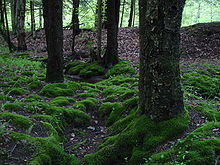
Mosses are small flowerless plants that typically grow in dense green clumps or mats, often in damp or shady locations. The individual plants are usually composed of simple leaves that are generally only one cell thick, attached to a stem that may be branched or unbranched and has only a limited role in conducting water and nutrients. Although some species have conducting tissues, these are generally poorly developed and structurally different from similar tissue found in vascular plants.[3] Mosses do not have seeds and after fertilisation develop sporophytes with unbranched stalks topped with single capsules containing spores. They are typically 0.2–10 cm (0.1–3.9 in) tall, though some species are much larger. Dawsonia, the tallest moss in the world, can grow to 50 cm (20 in) in height.
Mosses are commonly confused with lichens, hornworts, and liverworts.[4] Lichens may superficially look like mosses, and have common names that include the word "moss" (e.g., "reindeer moss" or "iceland moss"), but are not related to mosses.[4]:3 Mosses used to be grouped together with the hornworts and liverworts as "non-vascular" plants in the former division "bryophytes", all of them having the haploid gametophyte generation as the dominant phase of the life cycle. This contrasts with the pattern in all vascular plants (seed plantsand pteridophytes), where the diploid sporophyte generation is dominant.
Mosses are now classified on their own as the division Bryophyta. There are approximately 12,000 species.[2]
The main commercial significance of mosses is as the main constituent of peat (mostly the genus Sphagnum), although they are also used for decorative purposes, such as in gardens and in the florist trade. Traditional uses of mosses included as insulation and for the ability to absorb liquids up to 20 times their weight.
Moss is often considered a weed in grass lawns, but is deliberately encouraged to grow under aesthetic principles exemplified by Japanese gardening. In old temple gardens, moss can carpet a forest scene. Moss is thought to add a sense of calm, age, and stillness to a garden scene. Moss is also used in bonsai to cover the soil and enhance the impression of age.[32] Rules of cultivation are not widely established. Moss collections are quite often begun using samples transplanted from the wild in a water-retaining bag. However, specific species of moss can be extremely difficult to maintain away from their natural sites with their unique requirements of combinations of light, humidity, substrate chemistry, shelter from wind, etc.
Growing moss from spores is even less controlled. Moss spores fall in a constant rain on exposed surfaces; those surfaces which are hospitable to a certain species of moss will typically be colonised by that moss within a few years of exposure to wind and rain. Materials which are porous and moisture retentive, such as brick, wood, and certain coarse concrete mixtures are hospitable to moss. Surfaces can also be prepared with acidic substances, including buttermilk, yogurt, urine, and gently puréed mixtures of moss samples, water and ericaceous compost.
In the cool cloudy damp Pacific Northwest, moss is sometimes allowed to grow naturally as a lawn substitute, one that needs little or no mowing, fertilizing or watering. In this case, grass is considered to be the weed.[33] Landscapers in the Seattle area sometimes collect boulders and downed logs growing mosses for installation in gardens and landscapes. Woodland gardens in many parts of the world can include a carpet of natural mosses.[29] The Bloedel Reserve on Bainbridge Island, Washington State, is famous for its moss garden. The moss garden was created by removing shrubby underbrush and herbaceous groundcovers, thinning trees, and allowing mosses to fill in naturally.[34]
Mosses are sometimes used in green roofs. Advantages of mosses over higher plants in green roofs include reduced weight loads, increased water absorption, no fertilizer requirements, and high drought tolerance. Since mosses do not have true roots, they require less planting medium than higher plants with extensive root systems. With proper species selection for the local climate, mosses in green roofs require no irrigation once established and are low maintenance.[35]


I was delighted to find some moss growing around the roots of our mulberry tree on the north side of our property.
Monday, May 28, 2018
Thursday, May 24, 2018
Mornings Are NEVER Dull With 53 Baby Goats!!!...
I used to raise goats... The babies are so adorable!!!... Baaaa-aaaaa-aaaa-aaaaaaaaaaaaaaaa!!!... :D :D :D!!!
Wednesday, May 23, 2018
The Blackthorn...

The specific name spinosa is a Latin term indicating the pointed and thornlike spur shoots characteristic of this species. The common name "blackthorn" is due to the thorny nature of the shrub, and its very dark bark.
The word commonly used for the fruit, "sloe" comes from Old English slāh. The same word is noted in Middle Low German, historically spoken in Lower Saxony, Middle Dutch sleuuwe or, contracted form, slē, from which come Modern Low German words: slē, slī, and Modern Dutch slee, Old High German slēha", "slēwa, from which come Modern German Schlehe and Danish slåen.
The names related to 'sloe' come from the Common Germanic root *slaiχwōn. Cf. West Slavic / Polish śliwa; plum of any species, including sloe śliwa tarnina—root present in other Slavic languages, e.g. Croatian/Serbian šljiva / шљива, and Russian слива.
Sloe-eyed
The expression "sloe-eyed" for a person with dark eyes comes from the fruit, and is first attested in A. J. Wilson's 1867 novel Vashti.[7]
Ecology

The foliage is sometimes eaten by the larvae of Lepidoptera, including the small eggar moth, emperor moth, willow beauty, white-pinion spotted, common emerald, November moth, pale November moth, mottled pug, green pug, brimstone moth, feathered thorn, brown-tail, yellow-tail, short-cloaked moth, lesser yellow underwing, lesser broad-bordered yellow underwing, double square-spot, black and brown hairstreaks, hawthorn moth (Scythropia crataegella) and the case-bearer moth Coleophora anatipennella. Dead blackthorn wood provides food for the caterpillars of the concealer moth Esperia oliviella.
The pocket plum gall of the fruit caused by the fungus Taphrina pruni produces an elongated and flattened gall, devoid of a stone.
Uses


The shrub, with its savage thorns, is traditionally used in Britain and other parts of Northern Europe to make a cattle-proof hedge.
The fruit is similar to a small damson or plum, suitable for preserves, but rather tart and astringent for eating, unless it is picked after the first few days of autumn frost. This effect can be reproduced by freezing harvested sloes.
The juice is used in the manufacture of fake port wine, and used as an adulterant to impart roughness to genuine port. In rural Britain a liqueur, "sloe gin", is made by infusing gin with sloes and sugar. Vodka can also be infused with sloes.
In Navarre, Spain, a popular liqueur called pacharán is made with sloes. In France a similar liqueur called épine or épinette or troussepinette is made from the young shoots in spring. In Italy, the infusion of spirit with the fruits and sugar produces a liqueur called bargnolino (or sometimes prunella)—as well as in France where it is called "prunelle" (also the common name of the shrub) or "veine d'épine noire". Wine made from fermented sloes is made in Britain, and in Germany and other central European countries.
Sloes can also be made into jam, chutney, and used in fruit pies. Sloes preserved in vinegar are similar in taste to Japanese umeboshi. The juice of the fruits dyes linen a reddish colour that washes out to a durable pale blue.
Blackthorn makes an excellent fire wood that burns slowly with a good heat and little smoke. The wood takes a fine polish and is used for tool handles and canes. Straight blackthorn stems have traditionally been made into walking sticks or clubs (known in Ireland as a shillelagh). In the British Army, blackthorn sticks are carried by commissioned officers of the Royal Irish Regiment; this is a tradition also in Irish regiments in some Commonwealth countries.
The leaves resemble tea leaves, and were used as an adulterant of tea.
Shlomo Yitzhaki, a Talmudist and Tanakh commentator of the High Middle Ages, writes that the sap (or gum) of P. spinosa (which he refers to as the prunellier) was used as an ingredient in the making of some inks used for manuscripts.
The fruit stones have been found in Swiss lake dwellings. Evidence of the early use of sloes by man is found in the famous case of a 5,300-year-old human mummy discovered in 1991 in the Ötztal Alps along the Austrian-Italian border (nick-named Ötzi): among the stomach contents were sloes.
A "sloe-thorn worm" used as fishing bait is mentioned in the 15th-century work, The Treatyse of Fishing with an Angle, by Juliana Berners.
Tuesday, May 22, 2018


Friday, April 13, 2018
Wednesday, April 11, 2018
Tuesday, March 27, 2018
The Folklore Of Fairy Rings...


Many folk beliefs generally paint fairy rings as dangerous places, best avoided. Sikes traces these stories of people trespassing into forbidden territory and being punished for it to the tale of Psyche and Eros. In it, Psyche is forbidden to view her lover, and when she does so, her palace disappears and she is left alone. Superstition calls fairy circles sacred and warns against violating them lest the interloper (such as a farmer with a plough) anger the fairies and be cursed. In an Irish legend recorded by Wilde, a farmer builds a barn on a fairy ring despite the protests of his neighbours. He is struck senseless one night, and a local "fairy doctor" breaks the curse. The farmer says that he dreamed that he must destroy the barn.[60] Even collecting dew from the grass or flowers of a fairy ring can bring bad luck. Destroying a fairy ring is unlucky and fruitless; superstition says it will just grow back.
A traditional Scottish rhyme sums up the danger of such places:
Numerous legends focus on mortals entering a fairy ring—and the consequences. One superstition is that anyone who steps into an empty fairy ring will die at a young age. A 20th-century tradition from Somerset calls the fairy ring a "galley-trap" and says that a murderer or thief who walks in the ring will be hanged. Most often, someone who violates a fairy perimeter becomes invisible to mortals outside and may find it impossible to leave the circle. Often, the fairies force the mortal to dance to the point of exhaustion, death, or madness. In Welsh tales, fairies actively try to lure mortals into their circles to dance with them. A tale from the Cambrian Mountains of Wales, current in the 19th century, describes a mortal's encounter with a fairy ring:
Entering the ring on May Eve or Halloween night was especially dangerous. One source near Afon fach Blaen y Cae, a tributary of the Dwyfach, tells of a shepherd accidentally disturbing a ring of rushes where fairies are preparing to dance; they capture him and hold him captive, and he even marries one of them. In variants from Scotland recorded by Edwin Sidney Hartland in 1891, the ring is replaced by a cavern or an old mill.
Freedom from a fairy ring often requires outside intervention. A tactic from early 20th-century Wales is to cast wild marjoram and thyme into the circle and befuddle the fairies; another asks the rescuer to touch the victim with iron. Other stories require that the enchanted victim simply be plucked out by someone on the outside, although even this can be difficult: A farmer in a tale from the Llangollen region has to tie a rope around himself and enlist four men to pull him from the circle as he goes in to save his daughter.[71] Other folk methods rely on Christian faith to break the enchantment: a stick from a rowan tree (thought to be the wood from which the cross of Jesus Christ was built) can break the curse, as can a simple phrase such as "what, in Heaven's name", as in a 19th-century tale from Carmarthenshire. A common element to these recoveries is that the rescuer must wait a year and a day from when the victim entered the ring.
Mortals who have danced with the fairies are rarely safe after being saved from their enthrallment. Often, they find that what seemed to be but a brief foray into fairyland was indeed much longer in the mortal realm, possibly weeks or years. The person rescued from the fairy ring may have no memory of their encounter with the sprites, as in a story from Anglesea recorded in 1891. In most tales, the saved interlopers face a grim fate. For example, in a legend from Carmarthenshire, recorded by Sikes, a man is rescued from a fairy ring only to crumble to dust. In a tale from Mathavarn, Llanwrin Parish, a fairy-ring survivor moulders away when he eats his first bite of food. Another vulnerability seems to be iron; in a tale from the Aberystwyth region, a touch from the metal causes a rescued woman to disappear.
Some legends assert that the only safe way to investigate a fairy ring is to run around it nine times. This affords the ability to hear the fairies dancing and frolicking underground. According to a 20th-century tradition of Northumberland, this must be done under a full moon, and the runner must travel in the direction of the sun; to go widdershins allows the fairies to place the runner under their sway. To circle the ring a tenth time is foolhardy and dangerous. Keightley recorded a similar tradition from Northumberland in 1905: "The children constantly run this number [nine times], but nothing will induce them to venture a tenth run." A story from early 20th century England says that a mortal can see the sprites without fear if a friend places a foot on that of the person stepping beyond the circle's perimeter.[76] Another superstition says that wearing a hat backwards can confuse the fairies and prevent them from pulling the wearer into their ring.
Although they have strong associations with doom, some legends paint fairy circles as places of fertility and fortune. Welsh folk belief is that mountain sheep that eat the grass of a fairy ring flourish, and that crops sown from such a place will prove more bountiful than those from normal land. A folk belief recorded in the Athenian Oracle claims that a house built on a fairy circle will bring prosperity to its inhabitants.[78] Likewise, a legend from Pont y Wern says that in the 13th or 14th century, the inhabitants of the town of Corwrion watched fairies dancing in a ring around a glow worm every Sunday after church at a place called Pen y Bonc. They even joined the sprites in their revels. The legend survives in a rhyme: "With the fairies nimbly dancing round / The glow-worm on the Rising Ground." A Welsh tale recorded by Rhys in 1901 tells of a man who supposedly lived on the side of the Berwyn, above Cwm Pennant, in the early 19th century. The man destroyed a nest of rooks in a tree surrounded by a fairy ring. In gratitude, the fairies gave him a half crown every day but stopped when he told his friends, "for he had broken the rule of the fair folks by making their liberality known".[80] Nevertheless, fairy boons are not without their curses, and tales often tell of the sprites exacting their revenge.
Sunday, March 4, 2018

Subscribe to:
Posts (Atom)